

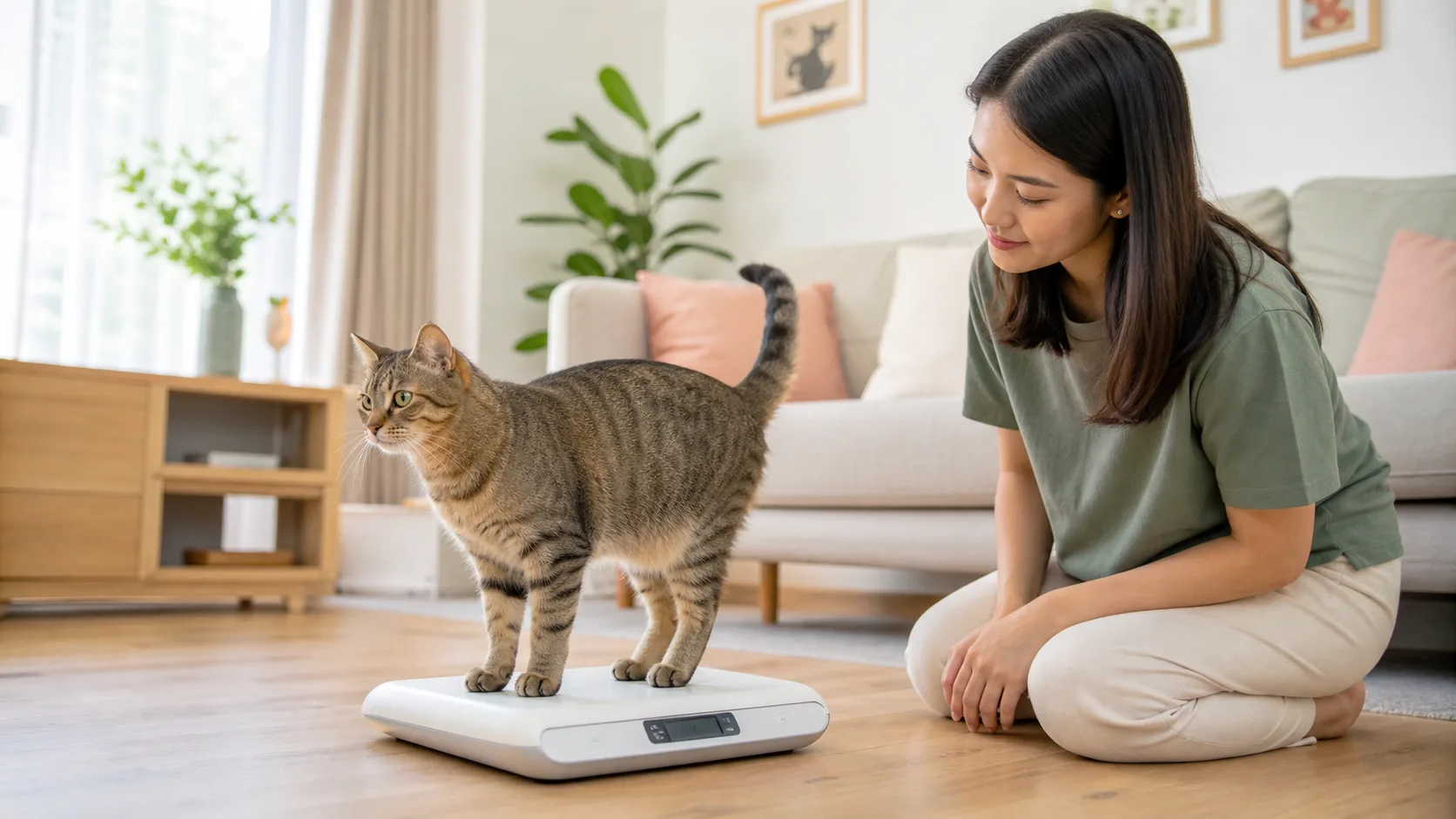
If you search for the average cat weight, you will often see a range of about 3.6 to 5.4 kg (8 to 12 lb) for an adult domestic cat. That is a useful starting point, but it is not a universal target.
A compact adult cat may be healthy below that range. A large-framed cat may be healthy above it. Breed, sex, age, body frame, muscle mass, and health all affect what is right for an individual cat.
The better question is not only, “How much does my cat weigh?” It is also, “Does my cat have a healthy body condition, and is their weight stable?”
This guide explains how to use the number on the scale together with a simple body-condition check at home.
What is the average weight of an adult cat?
Many adult domestic cats weigh around 3.6 to 5.4 kg (8 to 12 lb). However, averages can be misleading when they are treated as a pass-or-fail rule.
For example:
- A 4 kg domestic shorthair with an easy-to-feel rib cage and a visible waist may be at a healthy weight.
- A 4 kg smaller-framed cat with no visible waist and ribs that are difficult to feel may be carrying excess body fat.
- A 6 kg large-framed or muscular cat may be in good condition, while the same weight could be too high for a smaller cat.
This is why veterinarians assess body condition as well as weight. Your cat’s personal healthy range is more useful than a general average.
Treat the average cat weight range as context, then use body condition and your cat’s weight trend to make the number meaningful.
How to tell if your cat is a healthy weight
Veterinary teams often use a Body Condition Score (BCS). A common system runs from 1 to 9, with 5 out of 9 representing ideal body condition. The score looks at fat coverage and body shape rather than weight alone.
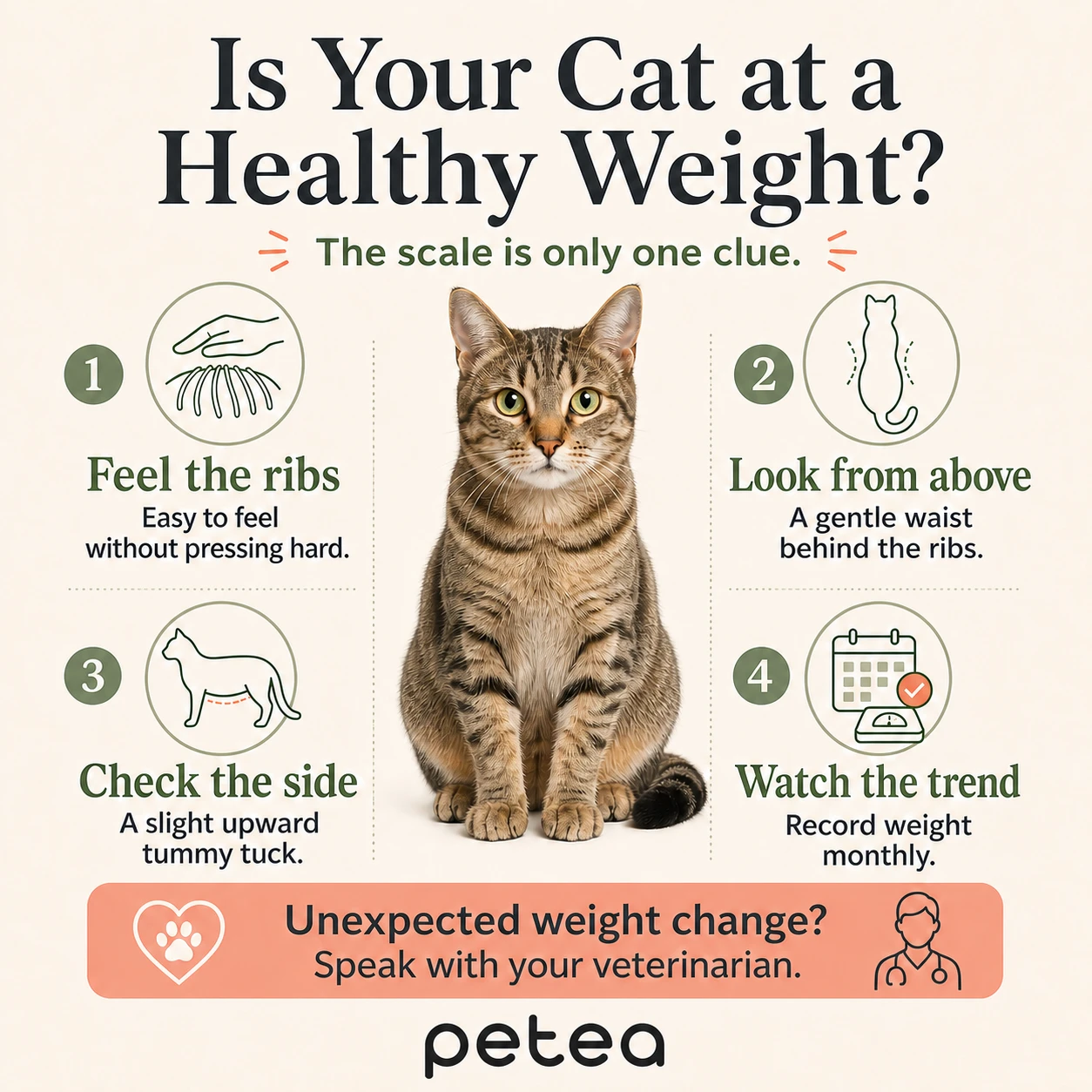
You can perform a simple check at home using three views.
1. Feel the ribs
Run your fingertips gently along both sides of your cat’s rib cage.
At a healthy body condition, you should be able to feel the ribs without pressing hard, but they should not look sharply visible. A thin layer of tissue over the ribs is normal.
If the ribs are difficult to find beneath a thick layer, your cat may be overweight. If the ribs, spine, and hip bones are very prominent, your cat may be underweight.
2. Look from above
When your cat is standing, look down at their back.
A cat in healthy condition usually has a visible waist behind the ribs. The shape does not need to be dramatic, but the body should not appear equally wide from chest to hips.
3. Look from the side
From the side, look for a slight upward tuck behind the rib cage and a small abdominal fat pad.
Do not judge your cat only by a hanging primordial pouch. Many healthy cats have this loose flap of skin and tissue along the belly. Use the rib, waist, and side checks together.
Why your cat’s weight may change
Small fluctuations can happen, but a clear upward or downward trend deserves attention.
Food portions and treats
Portion sizes can slowly grow without anyone noticing. A slightly full scoop, shared family feeding, frequent treats, and constant access to dry food can add more food than planned.
Consider a home with three people. One person serves breakfast, another gives a snack, and a third tops up the bowl because it looks empty. Each action seems small, but together they can make daily intake difficult to track.
Activity and indoor lifestyle
Indoor cats may spend much of the day resting. Play, climbing, and food-based enrichment can support movement, but activity needs vary between cats.
Age and muscle changes
Young adult cats may gain weight as growth slows. Older cats can lose muscle even when the number on the scale changes very little. This is one reason a body-condition and muscle assessment by a veterinarian is useful.
Health changes
Unexpected weight loss or gain can sometimes be linked to illness, pain, dental problems, appetite changes, or medication. Do not assume that every change is simply caused by feeding.
How to weigh and monitor your cat at home
You do not need to weigh your cat every day. What matters is using the same method and watching the trend.
Use a pet or baby scale
Place the scale on a firm surface and add a non-slip mat or thin towel if needed. Weigh your cat at roughly the same time of day for more consistent readings.
Use a bathroom scale
If your cat will not stand on a scale:
- Weigh yourself and record the number.
- Pick up your cat and weigh both of you together.
- Subtract your weight from the combined weight.
This method may not show very small changes, but it can reveal a clear trend.
Keep a simple monthly record
Record the date, weight, and any changes in appetite or activity. You can also take one photo from above and one from the side while your cat is standing.
For a healthy adult cat whose weight is stable, a monthly home check is usually practical. Your veterinarian may suggest a different schedule for kittens, senior cats, or cats following a treatment or weight-management plan.
Practical ways to support a healthy routine
The goal is consistency, not a sudden restrictive diet.
Measure the daily food amount
Use a kitchen scale or a consistent measuring tool. Follow the food label as a starting point, then ask your veterinarian whether the amount suits your cat’s age, body condition, activity, and health needs.
Account for treats
Treats and extras still contribute to the daily total. Make sure everyone in the household follows the same plan.
Use regular meal times
Predictable meals can make intake easier to monitor than repeatedly topping up a bowl. If dry food is part of your cat’s vet-approved feeding plan, Petea’s 3.5L Smart WIFI Automatic Pet Feeder can schedule portions and keep a feeding history. The listed portion is approximately 10 to 20 g, depending on kibble size, so weigh several dispensed portions before relying on the setting.
An automatic feeder can support consistency, but it does not decide how many calories your cat needs. Set the total daily amount with guidance from your veterinarian.
For more help with meal routines, read Cat Feeding Tips: How to Build a Healthier Daily Routine for Your Cat and How to Choose the Best Feeding Setup for Your Cat.
Encourage gentle activity
Short play sessions, climbing opportunities, and food puzzles can add movement and enrichment. Choose activities that suit your cat’s age and mobility.
When to speak with a veterinarian
Contact your veterinarian if your cat has unexplained weight loss or gain, especially when it happens quickly or alongside other changes.
Warning signs include:
- eating much more or less than usual;
- vomiting or diarrhoea;
- increased thirst or urination;
- low energy or reduced movement;
- difficulty chewing or dropping food;
- visible muscle loss;
- refusing food.
Never put an overweight cat on a crash diet. Cats need gradual, nutritionally complete weight management, and sudden severe food restriction can be dangerous.
Frequently asked questions
What is the average cat weight in kilograms?
The average cat weight for many adult domestic cats falls around 3.6 to 5.4 kg, but this is only a general range. Breed, frame, sex, age, and muscle mass matter. Body condition and weight trend are more useful than one universal target.
Is 5 kg overweight for a cat?
Not necessarily. A 5 kg cat may be healthy, overweight, or underweight depending on body frame and muscle mass. Check whether the ribs are easy to feel, whether there is a waist from above, and whether the body has a slight abdominal tuck. Ask your veterinarian to confirm.
How can I tell if my cat is overweight without a scale?
Use a body-condition check. The ribs should be easy to feel beneath a light covering, a waist should be visible behind the ribs from above, and there should be a slight tuck from the side. If the ribs are difficult to feel and there is no visible waist, arrange a veterinary assessment.
How often should I weigh my cat?
A monthly home weight check is a practical routine for many healthy adult cats. Kittens, senior cats, and cats on a veterinary weight-management plan may need more frequent monitoring.
Why is my cat losing weight even though they are eating?
Unplanned weight loss can have several causes and needs veterinary assessment. Increased appetite with weight loss, changes in thirst, vomiting, diarrhoea, or reduced muscle are especially important to report promptly.
The takeaway
The average cat weight is useful as a starting point, not a diagnosis. Look at your cat’s ribs, waist, side profile, muscle condition, and weight trend together.
Record a monthly weight and speak with your veterinarian if the number or body shape changes unexpectedly. A simple, consistent feeding routine makes those changes easier to notice.

